[ad_1]
Rain did not fall in sheets that night. It came down in a fine, persistent mist, the kind that slips past fabric and pride alike, sinking through black mourning clothes until the cold seems to settle somewhere inside the bones. I remember that detail with humiliating clarity, perhaps because grief always preserves the wrong things. It preserves weather, textures, sounds, and the exact angle of a hand when it lets go of you.
I was standing on the front lawn of the Washington estate when my mother-in-law hurled my old suitcase down the stone steps.
The suitcase had been mine long before I married Terrence Washington, long before I learned how vast the family’s money was, and long before I understood that wealth does not civilize cruelty so much as it gives it a polished vocabulary. The latch burst when it hit the wet ground. My clothes spilled into the mud, along with a folded cardigan, a pair of nursing scrubs, and the soft cream sweater I had worn the first time Terrence kissed me in a hospital parking lot after my shift ended at dawn.
Eleanor Washington stood at the top of the stairs, one hand still lifted from the throw, her mouth twisted into something that no longer even resembled grief.
“Get your trash off my lawn, Audrey,” she snapped.
Her voice cut through the drizzle with the precision of someone who had been waiting all day to speak freely.
“You had your grand wedding, your expensive flowers, your little fantasy,” she continued. “The entertainment is over. Terrence is gone, and now you have nothing. Get out of my sight, you parasitic little opportunist.”
To her right stood Chloe, Terrence’s younger sister, filming me on her phone with open delight, holding the screen at just the right angle to capture the wreckage. She laughed when one of my dresses landed in a puddle.
“Say goodbye to high society, sweetheart,” she called out. “I’m posting this. Everyone should see what happens when the garbage takes itself out. Did you really think that ridiculous prenup was going to let you carry off even a dollar of my family’s money?”
I did not scream.
I did not lunge at either of them.
I knelt in the mud, picked up the wedding album that had fallen half-open into the grass, and wiped the wet dirt gently from the photograph of Terrence’s face. I held the book against my chest like a shield and looked up at Eleanor through rain and humiliation and the strange, hollow calm that arrives when someone has already broken your heart badly enough that new damage can only land as information.
“You’re right,” I said quietly. “I have nothing.”
Then I turned and walked away without looking back at the house.
At the time, she thought she had stripped me of everything.
What Eleanor Washington did not understand was that there is a difference between being left with nothing and being left alone long enough to rebuild.
For six months, the Washington family behaved as though I had dissolved into the background exactly as they always expected I would. In their minds, I had returned to the only version of me they had ever found comfortable: the quiet pediatric nurse from a modest family, the widow who could be pitied in public and dismissed in private, the woman who had briefly wandered into their grand world by mistake and then been corrected by loss.
They went on attending galas, board dinners, and donor events under the assumption that the estate, the company, and the Washington name remained safely in their hands.
They believed the prenuptial agreement had erased me.
They believed Terrence had been sentimental but not strategic.
They believed I had been too heartbroken, too ordinary, and too dependent to understand what mattered.
That was their first mistake.
Their second mistake was assuming that because I had spent years caring for sick children, I did not understand the anatomy of decay in grown institutions.
Every Tuesday morning for twenty-four consecutive weeks, I did not report to the hospital.
I walked instead into the offices of Vance & Mercer, one of the most ruthless corporate law firms on the East Coast, and sat beneath a skylight in a conference room lined with polished shelves while attorneys, accountants, and forensic auditors spread the Washington empire out in front of me piece by piece.
By then I knew something the family did not.
Terrence had left me more than grief.
He had left me authority.
The weeks after his funeral were a blur of legal language, coded financial patterns, shell arrangements, trust registrations, corporate governance files, and old internal memoranda Terrence had quietly preserved. The deeper we dug, the clearer the structure became. Howard Washington, my father-in-law and the public face of the company, had been draining corporate funds for years to sustain a lifestyle he described as generational when it was, in truth, subsidized theft. Eleanor’s mansion expenditures, Chloe’s failed vanity startups, the yacht charter fees hidden as client entertainment, the renovation work on a “guest property” that existed only to house affairs and political favors—all of it had been stitched into the company’s books with the arrogance of people who assume no one patient enough will ever read all the pages.
I read every page.
And beneath that corruption sat the piece they never imagined Terrence would move.
He had owned fifty-one percent of the company.
Not Howard.
Not the family trust.
Terrence.
And in the final version of his will, signed three weeks before the accident that killed him, he transferred every controlling share and full voting authority to me.
Not because he thought I would preserve his family’s comfort.
Because he knew I would save the company from them.
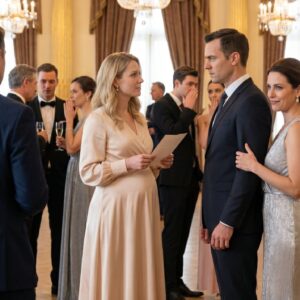
The Washington Foundation gala was held in late October at the Grand Lexington Hotel, a glittering monument to old money anxiety and charitable performance. The ballroom smelled of garden roses, polished marble, and the expensive false intimacy that clings to major donor events. Men in tuxedos laughed too loudly near the bar. Women wore diamonds with the composure of people who think refinement is a birthright rather than a discipline. At the center of it all, Howard Washington was preparing to receive an award for civic leadership while journalists and board members repeated versions of the same tired myth: that he had built everything with his own hands and that the Washington name still stood for stewardship.
Then a black Maybach pulled to the curb.
I stepped out wearing an emerald silk gown that fit like deliberate revenge and the Washington diamond necklace Eleanor once told me I was not refined enough to borrow, much less understand. Camera flashes pivoted. Conversations stalled. Heads turned in that small, synchronized motion crowds make when they sense scandal before they understand its shape.
Eleanor reached me first, moving fast enough to betray panic before she had time to disguise it.
“What are you doing here, Audrey?” she hissed. “Who did you deceive to buy that dress? Did you steal that necklace? Leave now before I have you escorted out in handcuffs.”
Howard followed, his face reddening with the strain of public rage.
“You are a discarded remnant of my son’s terrible judgment,” he said, keeping his voice low only because cameras were near. “This is a private event. You should disappear before I have security drag you out.”
I took a slow sip of mineral water from a passing tray and let the silence stretch just long enough to make his pulse visible at the temple.
“I would advise against that,” I said.
He laughed once, harshly.
“And why is that?”
I looked at him over the rim of the glass.
“Because it would be extremely unfortunate for the stock price if the company were seen physically ejecting its majority shareholder from her own charitable gala.”
For a moment he did not understand me.
Then the meaning reached him all at once.
Attorney Malcolm Vance stepped out from the crowd with a thick red-tabbed file in hand and passed it to Howard without ceremony.
“The final and controlling will of the late Terrence Washington,” he said clearly enough for the nearest two reporters to hear. “Mr. Washington held fifty-one percent of the company’s controlling shares. In this executed document, all such shares and voting rights were lawfully and permanently transferred to his wife, Audrey Washington.”
Eleanor’s handbag slipped from her fingers and hit the marble floor.
Chloe dropped her phone.
Howard opened the file and turned pages with the desperate speed of a man searching for a loophole where only consequence exists.
“No,” he said. “That is not possible. This company belongs to the Washington line. Terrence could not do this. I am the CEO.”
I met his eyes and answered with perfect calm.
“You were the CEO, Howard.”
When I stepped onto the stage a few minutes later, the ballroom had gone so still that even the clink of a champagne flute sounded intrusive. Howard remained below, pale and shaking, the file still open in his hands. Eleanor hovered near the front with the expression of a woman trying to decide whether tears or outrage would serve her better. Chloe looked less furious than frightened, which was appropriate. Fear, finally, was the most honest thing any of them had shown me in years.
I took the microphone and let the room settle.
“Terrence Washington was a generous man,” I said. “He was also not blind.”
A murmur moved through the crowd and then faded.
I looked directly at Howard.
“He knew company funds were being drained to support private estates, pleasure spending, and a string of pet projects that never produced anything except invoices. He knew the books were being dressed to conceal personal indulgence as operational necessity. And he chose me, not because I came from his world, but because I did not.”
I let that rest where it needed to.
“I am a pediatric nurse,” I continued. “My work has taught me how to protect what is fragile, how to recognize decline before the monitors begin screaming, and how to act when everyone else is still pretending the patient is stable. Terrence knew I would not bleed this company dry to preserve a family image. He knew I would save it.”
Then I said the sentence that ended Howard Washington’s reign.
“As majority shareholder, I am terminating Howard Washington as chief executive officer effective immediately, pending full cooperation with a federal investigation into financial misconduct and corporate misuse of assets.”
The room erupted.
Not chaotically at first, but in waves—gasps, whispers, a cluster of reporters rushing forward, board members backing away from Howard as though accountability might be contagious, and somewhere near the left wall, actual applause beginning from people who had long suspected something rotten inside the company and never expected to see it named aloud.
Howard sat down hard in the front row.
Eleanor rushed toward the stage with tears now fully deployed.
“Audrey, sweetheart,” she cried. “Please. I was grieving. We were all grieving. I was not myself. We are family. Don’t do this to us.”
I took one step backward so she could not touch my dress.
“Grief,” I said, “does not throw a dead man’s widow into the rain and drag his photograph through the mud. That was not grief. That was cruelty.”
Then I turned slightly and addressed the security staff.
“Please escort the non-shareholders from the ballroom,” I said. “They are affecting the atmosphere of the charitable program.”
As they moved in, Eleanor began pleading louder. Chloe cursed. Howard remained seated, staring forward with the dead-eyed emptiness of a man who had finally reached the end of his borrowed importance.
Then I added one final detail into the microphone, because some lessons are only fully understood when they circle back to the beginning.
“And Eleanor,” I said lightly, “the Greenwich residence where you are currently living is titled as a corporate asset. It belongs to the company, which means it now belongs to me. You have twenty-four hours to vacate. If you remain past tomorrow at midnight, I will have your luggage placed on the lawn.”
I smiled.
“I believe you’re already familiar with how that process works.”
Three months later, Howard was facing federal charges. Eleanor and Chloe had moved into a cramped rental outside the city, where the walls were thin, the closets too small, and the neighbors lacked the courtesy to pretend old wealth mattered once the invoices stopped clearing. Several former board members, suddenly eager to preserve their reputations, cooperated enthusiastically with investigators. The company survived, though only because it was forced through a brutal and honest restructuring that Terrence had tried unsuccessfully to begin while he was alive.
I took the corner office eventually, not because I had ever wanted power for its own sake, but because stewardship is easiest to abuse when left in careless hands.
The first week I sat behind that desk, I brought in the muddy suitcase.
I had the latch repaired but left one of the scuffs untouched.
Not as sentimentality.
As evidence.
I kept the wedding album too, cleaned and restored, though I no longer opened it often. Terrence had not been perfect, and love had not been simple, but he had seen enough to know what kind of people surrounded him and what kind of woman he was trusting to clean up the wreckage after him.
One evening, long after most of the staff had left, I stood alone in the office and touched my wedding ring where it rested against the chain I now wore around my neck.
“I did it,” I said into the quiet. “I saved what you were trying to protect.”
The family believed that throwing me into the mud had reduced me to it.
What they never understood is that mud is not only where things decay.
It is also where things take root.
They thought they were burying me.
They were only planting the version of me they could never control.
THE END