[ad_1]
The moment that quietly reshaped the structure of my family began with a single sharp sound that echoed through a crowded living room on a warm weekend afternoon, the kind of ordinary gathering where relatives drift between conversations, children scatter toys across the carpet, and everyone assumes that nothing truly serious will happen because it is, after all, simply another family visit.
My son, a five-year-old boy named Lucas, had been playing on the floor with a small collection of toy cars that he had brought from home, carefully arranging them in long winding lines that stretched across the rug while my nephew Adrian, who was a year older and had already developed the stubborn confidence that sometimes comes with being the favored grandchild, wandered over and picked up the red race car Lucas treasured the most.
At first it was nothing more than the small friction that often occurs between children who have not yet learned how to share territory, because Lucas calmly asked for the toy back and Adrian refused with a grin that suggested he enjoyed the power of saying no.
Within seconds, the tension escalated.
Adrian shoved Lucas backward with both hands, which caused the small line of cars to scatter across the floor, and Lucas reacted instinctively by pushing him away in return, not with cruelty but with the desperate frustration of a child trying to protect something that belonged to him.
What happened next unfolded so quickly that it took several seconds for anyone in the room to process it.
My mother, Margaret, who had been watching television from the armchair beside the window, stood abruptly and strode across the room with the rigid authority she had carried her entire life, never pausing to ask a single question or listen to either child explain what had actually happened.
Her hand moved before anyone could intervene.
The sound of the slap cracked through the room with a sharp, hollow echo.
Lucas froze where he stood, his small body completely still as if time itself had suddenly stopped moving, while the red outline of five fingers slowly appeared across his cheek.
For a moment nobody spoke.
Then my mother’s voice erupted with furious certainty.
— “You little troublemaker! Do you think you’re brave enough to hit your older cousin?” — she shouted, her tone full of accusation that carried no trace of doubt.
Behind her, Adrian peeked out with a smug smile, still clutching the toy car Lucas had tried to retrieve, clearly aware that the adults had already chosen which child they believed.
My mother turned toward me with an expression that felt both familiar and deeply unsettling, the same sharp judgment she had used throughout my childhood whenever she believed I had failed to meet her expectations.
— “Emily, what are you standing there for?” — she snapped. — “Make Lucas apologize immediately. Honestly, I don’t know what kind of parenting you think you’re doing.” —
My older brother and his wife emerged from the kitchen at that moment, drawn by the noise yet strangely quick to assume that my son must have been the one responsible for the chaos.
My sister-in-law laughed softly beneath her breath before adding her own quiet remark.
— “He really does take after Emily,” — she said with a dismissive shrug. — “Always dramatic.” —
Throughout the entire exchange I remained silent.
Instead of responding, I knelt down and gently lifted Lucas into my arms.
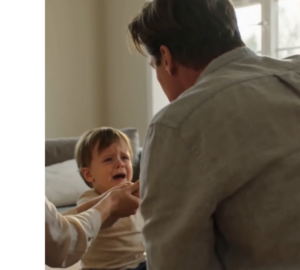
His small hands clung tightly to my shirt as he began to cry in uneven breaths, the confusion in his voice cutting deeper than the red mark on his face.
— “Mom… did I do something bad?” — he whispered. — “I only wanted my car back… he pushed me first.” —
I held him closer, pressing his head against my shoulder while the room continued buzzing with judgment behind us.
— “No, sweetheart,” — I told him quietly. — “You didn’t do anything wrong. The situation was wrong, not you.” —
Without saying another word to anyone in that house, I carried my son toward the door.
Behind me my mother’s voice exploded again, louder than before.
— “Emily, if you walk out now you might as well not come back!” —
I did not stop.
— “Fine!” — she shouted after me. — “Leave then. Don’t expect this family to welcome you again.” —
The elevator ride down to the lobby felt strangely quiet after the tension upstairs, as though the building itself had absorbed the echoes of the argument and sealed them away behind its walls.
When the doors opened, my husband Michael was standing near the entrance with his travel bag still slung over one shoulder, having just returned from a short business trip that had ended only minutes earlier.
The moment he saw Lucas’s face, the calm expression he usually carried vanished.
His eyes locked onto the bright imprint on our son’s cheek.
— “Who did that?” — he demanded.
His voice was not loud, yet the restrained anger inside it made the question feel heavier than a shout.
I explained what had happened in a few quiet sentences.
Michael immediately stepped toward the elevator, clearly intending to return upstairs and confront my family directly.
I caught his arm before he could move any farther.
— “Don’t,” — I said.
He looked at me in confusion.
— “Why not?” — he asked. — “They hit our son.” —
I shook my head slowly.
— “If you go up there now, it will become another meaningless argument that ends with everyone pretending nothing serious happened,” — I told him. — “I want something clearer than that.” —
Instead of returning upstairs, we drove directly to the nearest hospital so a doctor could examine Lucas’s injury.
The mark on his cheek had already darkened into a deep shade of red, and although he had stopped crying, he remained unusually quiet during the entire drive.
Inside the examination room, the physician carefully inspected the bruise while asking gentle questions about what had occurred.
After documenting the injury, he looked at us with professional seriousness.
— “This type of incident can be formally recorded if you choose,” — he explained. — “Would you like to file a report describing what happened?” —
I glanced at Michael, then back at the doctor.
— “Yes,” — I said firmly. — “Please document everything.”

We photographed the imprint on Lucas’s cheek before leaving the hospital, making sure every detail was recorded clearly.
That evening, once Lucas had fallen asleep, Michael and I returned to my mother’s house.
From the hallway outside the living room we could already hear laughter drifting through the door, the cheerful noise of people enjoying dessert and conversation as if the afternoon had never contained anything unusual.
When we entered the room, the atmosphere shifted slightly.
My mother leaned back in her chair and gave a faint, dismissive smile.
— “Well,” — she said coolly. — “Look who decided to come back.” —
My sister-in-law smirked as she glanced toward Lucas’s empty stroller beside us.
— “Honestly, Emily,” — she added. — “Making such a spectacle over a single slap is a little excessive.” —
I placed a folder on the coffee table.
Inside were the medical documents along with the photographs taken at the hospital.
— “Lucas deserves an apology,” — I said calmly. — “And the doctor has officially recorded what happened as physical assault.” —
The room fell silent.
My brother stared at the papers as if he had suddenly discovered something far more serious than he expected.
— “You did what?” — he asked slowly.
My mother’s confident expression began to fade.
— “Emily… you wouldn’t actually involve authorities over a family misunderstanding,” — she said, her voice wavering.
Michael answered before I could respond.
— “That decision won’t be ours alone,” — he said evenly. — “It will be handled by the proper channels.” —
Two days later another revelation changed everything again.
A lawyer contacted me regarding property documents connected to my late father’s estate, something I had not thought about in many years because the paperwork had always been handled quietly within the family.
During that call I learned something astonishing.
The house where my mother, brother, and their families had lived for decades was legally registered under my name.
My father had arranged the ownership twenty years earlier, creating a legal structure that transferred full control to me once I turned thirty, though my mother had continued managing the property as if nothing had changed.
According to the lawyer, she had known the arrangement all along.
She had simply never mentioned it.
When I returned to the house with the official documents in my hand, the same living room where Lucas had been struck only days earlier felt strangely different, as though the balance of power inside those walls had quietly shifted.
I laid the papers on the table.
— “Everyone will need to move out within thirty days,” — I said.
The reaction was immediate.
My brother jumped to his feet in disbelief.
— “Are you out of your mind?” — he shouted. — “This is our home.” —
I shook my head gently.
— “Legally speaking,” — I replied, — “it has always belonged to me.” —
My mother began to cry, her voice trembling as she reached for the edge of the table.
— “Emily… I am still your mother,” — she said.
For a long moment I simply looked at her.
— “A grandmother,” — I answered quietly, — “should never strike a child.” —
Thirty days later the house was empty.
For the first time in decades the rooms were quiet, free from the constant tension that had quietly defined my family for most of my life.
Lucas wandered through the living room one afternoon, studying the sunlight stretching across the floor where his toy cars were now neatly arranged again.
He looked up at me with a thoughtful expression.
— “Mom,” — he asked softly, — “is Grandma still mad at me?” —
I knelt beside him and took his small hand.
— “No, sweetheart,” — I said. — “Sometimes grown-ups need time to learn their own lessons.” —
He seemed satisfied with that answer.
Outside the window the afternoon sunlight filled the quiet house, and for the first time in many years I realized that peace had finally arrived.